What is PopUp Mainframe?
The PopUp Vision
PopUp Mainframe was born from a simple idea: what if we could make deploying real mainframe capability as simple as spinning up a virtual machine image on Linux on Z or x86?
Well, it took some truly concerted effort and a lot of manpower but that's exactly what we have built.
Learn more about the PopUp Vision.
The Challenge of Mainframe Environments
All mainframe clients have a common problem: The shortage of non-prod environments for development and test.
PopUp directly addresses this with instantly available, fully functioning mainframes.
It's easy to make PopUp look and behave exactly the same as your physical mainframe environments as you can install any mainframe subsystem or bespoke application on your PopUp. We also provide simplified migration utilities to transfer the data existing in your physical mainframe to your PopUp mainframe..
PopUp revolutionizes your mainframe SDLC, accelerating delivery and cutting hardware costs.
How does PopUp work?
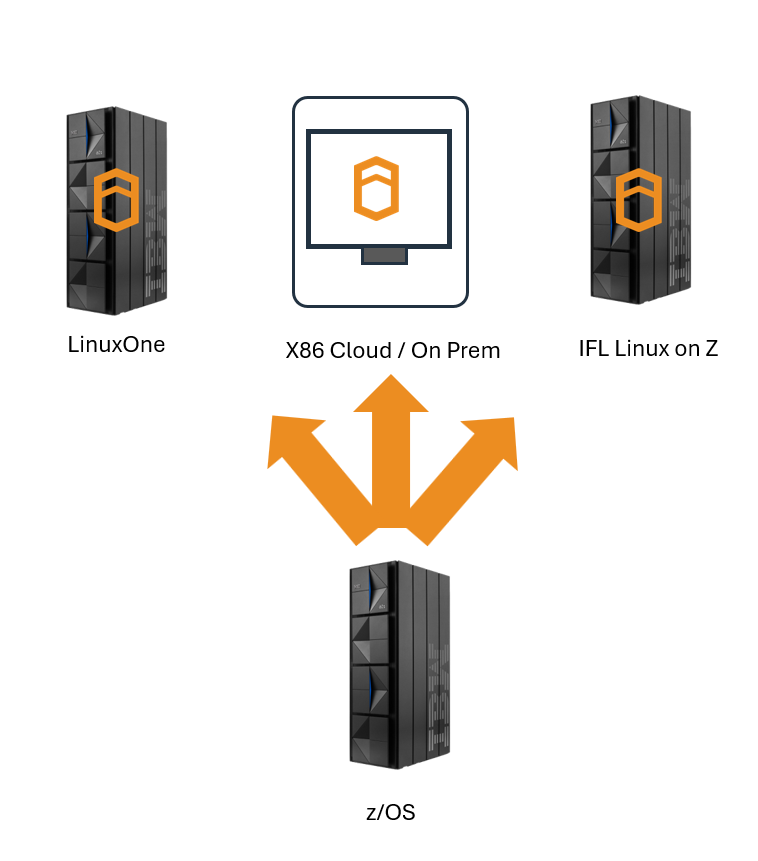
PopUp Mainframe comes packaged as a fully featured, optimized virtual machine image which can be run on Linux on Z, or any x86 architecture, on-premise or in the cloud. This provides a turnkey solution enabling rapid, elastic deployment of z/OS capability suitable for all non-production use cases (including dev, test, training, issue replication & troubleshooting).
Functionally equivalent to z/OS , PopUp Mainframe runs under Linux on Z, LinuxOne, or Cloud / On-prem x86 servers.
- Flexibility – Fasttrack facility enables rapid restart of development/test activities; Ansible playbooks automate admin tasks.
- Integration – Compatible with IBM, BMC, 3rd party, and open source mainframe tools; supports DevOps and data masking tools.
- z/OS Equivalency – Runs on Linux (Z or x86), behaves like z/OS, and supports all z/OS software and subsystems.
- Start/Stop in Seconds – Can be initiated or shut down in under 2 minutes, providing full flexibility and saving power/emissions.
- Accelerated Delivery – PopUp environment accelerates the mainframe delivery process by 400%.
PopUp can explicitly support improvements in the areas of speed, flexibility, cost, sustainability, risk, and skills.
A PopUp Mainframe image consists of an optimized Red Hat Enterprise Linux distribution, with pre-installed and pre-configured IBM's ZD&T software, a popular selection of IBM's Enterprise software offerings and a bunch of handy utilities from us to make everything run sweetly.
A PopUp mainframe is functionally equivalent to running a physical mainframe: it can be used for any non-prod purpose you might use a physical mainframe for.
Note: the software license excludes performance testing and production environment use.
Using PopUp
 The PopUp Lifecycle diagram shows the typical lifecycle of a PopUp, including:
- installing and tailoring your PopUp
- moving applications and data across
- creating a PopUp Gold Image
- and integrating with Delphix for virtualisation and masking if applicable
Our Best Practice guidance helps you to get the most out of your PopUp.
What is the Difference Between PopUp and ZD&T?
What is the Difference Between PopUp and ZD&T? from PopUp Mainframe.
PopUp Mainframe is built on IBM's tried and trusted ZD&T software. However, ZD&T is complex to install and configure, requiring a significant time investment from senior resources across many diferent teams. And that's just to get z/OS working properly.
What differentiates PopUp Mainframe from a self installed and configured ZD&T instance is the years of subject matter expertise we have built up to make the adoption of ZD&T as quick and painless as possible.
Platform
The standard PopUp image contains the following pre-configured IBM capabilities, ready to run:
- CICS
- IMS
- Db2
- MQ
- and more, see full list here
The PopUp Mainframe virtual machine image runs on Red Hat Enterprise Linux or Ubuntu. See Release Notes for details.
PopUp overcomes multiple challenges around reliably provisioning ZD&T mainframe environments, and includes many handy utility programs to streamline common administrative tasks. Such as:
- Ansible playbooks to automate a wide range of activities
- Data and application migration
- Allocation and management of storage volumes
- Start & stop scripts
- Master console message interaction and automated action trigger routines
For full details on the different styles of architecture and integrations supported with PopUp, see PopUp Architecture and Integrations.
Page last revised on: 2026-01-15